
As Pakistan continues to experience rapid urbanization, commercial expansion, and infrastructure development, the demand for efficient cooling solutions has never been higher. From shopping malls and hospitals to universities, airports, office towers, and industrial facilities, maintaining a comfortable indoor environment is essential for productivity, customer satisfaction, and operational efficiency.
One of the most effective cooling solutions for large-scale facilities is a chiller system. Chillers play a critical role in commercial HVAC systems by removing heat from buildings and providing consistent cooling throughout the year. However, choosing the right chiller for a commercial or public building is a significant investment that requires careful planning and technical evaluation.
Selecting the wrong chiller can lead to higher energy costs, poor performance, increased maintenance expenses, and reduced system lifespan. On the other hand, choosing the right solution can improve energy efficiency, lower operating costs, and ensure long-term reliability.
What Is a Chiller System?
A chiller is a cooling machine that removes heat from a liquid through a refrigeration cycle. The chilled water is then circulated through air handling units, fan coil units, or other HVAC equipment to cool indoor spaces.
Chillers are widely used in:
- Shopping malls
- Hospitals
- Hotels
- Educational institutions
- Corporate offices
- Airports
- Government buildings
- Manufacturing facilities
- Data centers
- Mixed-use developments
Because of their ability to cool large spaces efficiently, chillers have become the preferred cooling solution for many commercial and public facilities.
Why Choosing the Right Chiller Matters
A chiller often represents one of the largest investments in a building’s HVAC infrastructure.
The right chiller can provide:
- Reduced energy consumption
- Lower operational costs
- Improved occupant comfort
- Better indoor air quality
- Increased equipment lifespan
- Reliable cooling performance
- Reduced environmental impact
A poorly selected system can create ongoing challenges that affect building operations for years.
Understanding Cooling Requirements
The first step in selecting a chiller is determining the building’s cooling load.
Cooling load refers to the amount of heat that must be removed from a building to maintain the desired indoor temperature.
Factors affecting cooling load include:
Building Size
Larger buildings require greater cooling capacity.
Occupancy Levels
Buildings with high foot traffic generate more heat.
Equipment Usage
Computers, machinery, lighting systems, and electrical equipment contribute to heat generation.
Climate Conditions
Pakistan’s hot summers significantly impact cooling requirements.
Building Design
Glass facades, insulation quality, and building orientation influence cooling demand.
A professional load calculation helps ensure the chiller is properly sized.
Types of Chillers Available
Understanding the available chiller options is essential before making a decision.
Air-Cooled Chillers
Air-cooled chillers use ambient air to remove heat from the refrigeration cycle.
Advantages
- Easier installation
- Lower initial investment
- Reduced water consumption
- Less maintenance complexity
Ideal Applications
- Office buildings
- Educational facilities
- Retail centers
- Medium-sized commercial projects
Air-cooled chillers are commonly used in Pakistan due to their relatively simple installation requirements.
Water-Cooled Chillers
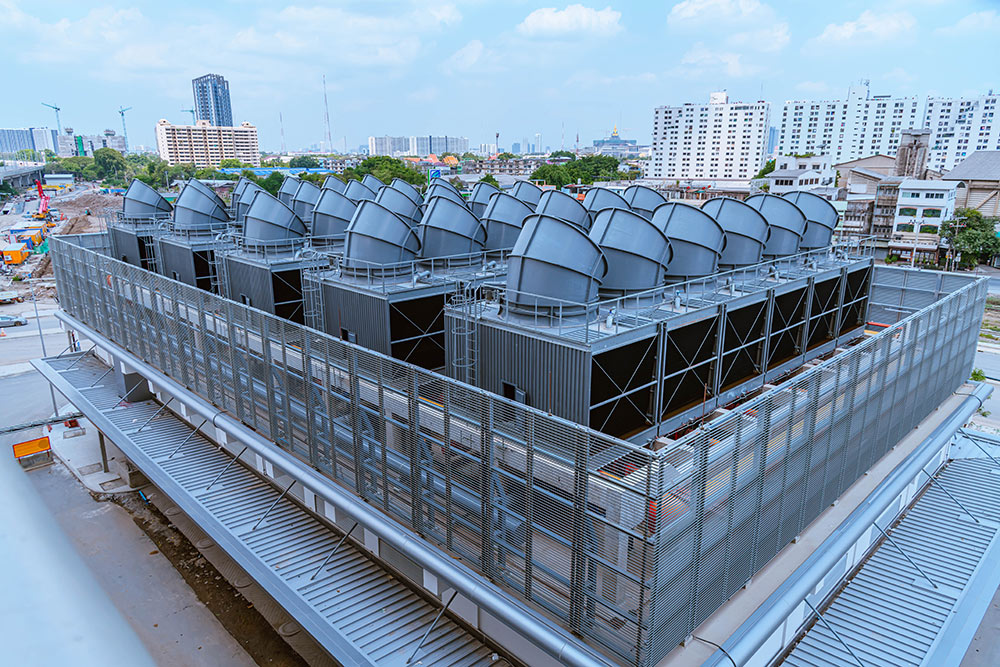
Water-cooled chillers use cooling towers to reject heat.
Advantages
- Higher energy efficiency
- Better performance in hot climates
- Longer equipment lifespan
- Lower operating costs for large facilities
Ideal Applications
- Hospitals
- Airports
- Large shopping malls
- Industrial facilities
- High-rise commercial towers
For large-scale projects, water-cooled systems often provide superior long-term value.
Consider Energy Efficiency
Energy consumption is one of the most important factors when selecting a chiller.
Since chillers often operate for extended periods, inefficient equipment can significantly increase electricity bills.
Look for:
- High-efficiency compressors
- Variable speed drives (VSDs)
- Advanced control systems
- Energy-saving technologies
Benefits of energy-efficient chillers include:
- Lower utility costs
- Reduced carbon emissions
- Faster return on investment
- Improved sustainability performance
With rising energy costs in Pakistan, efficiency should be a top priority.
Evaluate Pakistan’s Climate Conditions
Pakistan experiences extreme temperatures in many regions, particularly during summer.
Cities such as:
- Lahore
- Karachi
- Islamabad
- Faisalabad
- Multan
- Peshawar
often experience prolonged periods of high temperatures.
When selecting a chiller, consider:
- Peak summer temperatures
- Humidity levels
- Seasonal variations
- Dust and environmental conditions
A chiller designed for local climate conditions will provide more reliable performance throughout the year.
Choose the Correct Chiller Capacity
One of the most common mistakes is selecting a chiller that is either too large or too small.
Oversized Chillers
Problems may include:
- Increased energy consumption
- Frequent cycling
- Higher maintenance costs
- Reduced efficiency
Undersized Chillers
Problems may include:
- Inadequate cooling
- Increased equipment strain
- Shorter lifespan
- Occupant discomfort
Proper engineering calculations are essential to determine the correct capacity.
Consider Long-Term Operating Costs
Many organizations focus only on the purchase price.
However, lifecycle cost analysis provides a more accurate picture of overall value.
Costs to evaluate include:
- Initial equipment cost
- Installation expenses
- Energy consumption
- Maintenance costs
- Repair expenses
- Replacement parts
- Equipment lifespan
A slightly higher upfront investment often results in significant long-term savings.
Assess Reliability and System Durability
Commercial and public buildings depend on uninterrupted cooling.
System failures can affect:
- Customer experience
- Employee productivity
- Equipment operation
- Patient care in healthcare facilities
Look for features such as:
- Proven technology
- Durable construction
- Quality components
- Advanced monitoring systems
Reliability should always be a key consideration.
Importance of Smart Controls and Automation
Modern chillers incorporate intelligent control systems that optimize performance.
Smart controls can:
- Monitor system operation
- Reduce energy usage
- Detect faults early
- Improve efficiency
- Simplify maintenance
Advanced automation provides facility managers with greater visibility and control over HVAC operations.
Maintenance Requirements Matter
Routine maintenance is essential for maximizing chiller performance.
Before selecting a system, evaluate:
- Ease of servicing
- Availability of replacement parts
- Accessibility of components
- Maintenance schedules
A system that is easier to maintain can significantly reduce downtime and operating costs.
Environmental Considerations
Sustainability is becoming increasingly important for commercial and public projects.
Modern chillers can help reduce environmental impact through:
- Energy-efficient operation
- Reduced greenhouse gas emissions
- Environmentally friendly refrigerants
- Lower power consumption
Many organizations now prioritize green building standards and sustainability initiatives.
Industry-Specific Chiller Selection
Different facilities have different cooling requirements.
Hospitals
Hospitals require:
- Reliable operation
- Precise temperature control
- Continuous performance
Shopping Malls
Malls require:
- Large cooling capacity
- High efficiency
- Occupant comfort
Educational Institutions
Schools and universities benefit from:
- Cost-effective operation
- Easy maintenance
- Energy efficiency
Data Centers
Data centers require:
- Precise cooling
- Redundancy systems
- Continuous uptime
Understanding your facility’s specific needs helps ensure the best equipment selection.
Why Professional Assessment Is Essential
Every commercial building has unique cooling requirements.
A professional HVAC assessment can help determine:
- Required capacity
- Equipment type
- Installation requirements
- Energy-saving opportunities
- Lifecycle cost projections
Professional planning reduces risk and improves long-term performance.
Common Mistakes to Avoid When Choosing a Chiller
Many buyers make avoidable mistakes during the selection process.
Choosing Based Solely on Price
The cheapest option is not always the most cost-effective.
Ignoring Energy Efficiency
Higher energy bills can quickly outweigh initial savings.
Incorrect Sizing
Improper capacity selection affects performance and reliability.
Overlooking Maintenance Requirements
Difficult maintenance increases operational costs.
Failing to Consider Future Expansion
Buildings often grow, and cooling systems should accommodate future needs.
Avoiding these mistakes helps maximize return on investment.
The Future of Chiller Technology in Pakistan
The HVAC industry continues to evolve with innovations focused on efficiency and sustainability.
Emerging trends include:
- AI-driven system optimization
- Predictive maintenance
- Smart building integration
- Advanced energy management
- Eco-friendly refrigerants
- Internet-connected monitoring systems
Organizations investing in modern chiller technology today will be better positioned for future operational demands.
Frequently Asked Questions (FAQs)
- What type of chiller is best for large commercial buildings?
Answer:
Water-cooled chillers are often the preferred choice for large commercial buildings because they provide higher energy efficiency, better performance in hot climates, and lower operating costs over the long term.
- How do I determine the correct chiller size for my building?
Answer:
A professional HVAC load calculation is required to determine the correct chiller capacity. Factors such as building size, occupancy, equipment usage, insulation, and climate conditions all influence sizing requirements.
- Are energy-efficient chillers worth the investment?
Answer:
Yes. Although energy-efficient chillers may have a higher initial cost, they typically deliver significant savings through reduced electricity consumption and lower operating expenses over their lifespan.
- What is the difference between air-cooled and water-cooled chillers?
Answer:
Air-cooled chillers use ambient air to remove heat and are generally easier to install, while water-cooled chillers use cooling towers and offer greater efficiency for large-scale applications.
- How often should a commercial chiller be maintained?
Answer:
Most commercial chillers should be inspected regularly and receive professional preventive maintenance at least twice a year. Routine maintenance helps improve efficiency, prevent breakdowns, and extend equipment lifespan.